Mag Drill vs Drill Press: When Does a Magnetic Drill Make Sense?
Table of Contents
- Mag Drill vs Drill Press: Quick Comparison
- What Is a Mag Drill?
- What Is a Drill Press?
- Mag Drill vs Drill Press: What's the Real Difference?
- When to Use a Magnetic Drill
- When Is a Drill Press the Better Choice?
- What Does a Mag Drill Need to Hold Safely?
- Annular Cutters vs Twist Drills: Why It Matters
- Mag Drill Limitations to Consider
- Mag Drill Cost, Tooling, and Setup
- Mag Drill or Drill Press? A Simple Decision Guide
- FAQs
A drill press works best when you can bring the workpiece to the machine. A magnetic drill, or mag drill, does the opposite: it lets you bring the drilling machine to large, heavy, installed, or difficult-to-move steel.
That makes a mag drill the better choice for structural steel, field fabrication, bridge work, large plate, vertical drilling, and many jobs where moving the workpiece simply isn't practical. A drill press is usually the better choice for smaller parts, repetitive shop work, and applications where portability doesn't matter.
Mag Drill vs Drill Press: Quick Comparison
| Consideration | Mag Drill | Drill Press |
|---|---|---|
| Portability | Designed to travel to the workpiece | Stationary or semi-stationary |
| Best for | Structural steel, large plate, installed steel, field work | Small to medium parts and repetitive shop work |
| Workpiece handling | Workpiece can remain in place | Workpiece is normally brought to the machine |
| Vertical drilling | Possible with the proper setup and suitable magnetic surface | Generally impractical |
| Overhead drilling | Possible with machines and procedures designed for the application | Generally impractical |
| Repeatability | Good, but repositioning is usually required between holes | Excellent for repeated operations using stops, fixtures, and a fixed table |
| Common tooling | Annular cutters; many models can also use twist drills and other tooling | Twist drills and a wide range of drill-press tooling |
| Material limitations | Magnetic base requires a suitable ferromagnetic surface or alternative mounting method | Can work with steel, aluminum, wood, plastics, and many other materials |
| Cost of entry | Typically higher for a professional machine | Wide range, including relatively inexpensive benchtop models |
What Is a Mag Drill?
A mag drill, also called a magnetic drill or magnetic drill press, is a portable drilling machine with a magnetic base that attaches the machine directly to ferromagnetic metal, usually steel.
Once the magnet is engaged and adequate holding force is established, the base helps keep the drill stable while the operator feeds the cutter into the work. Instead of trying to support a powerful handheld drill while making a large hole, the mag drill effectively creates a temporary drilling station on the workpiece itself.
This is what makes a magnetic drill so useful on structural steel. You don't have to move the beam, plate, frame, or installed component to a stationary machine. You take the machine to the hole.
Mag drills are most commonly associated with annular cutters, although many machines can also accept twist drills, countersinks, reamers, taps, and other tooling depending on the spindle and model.
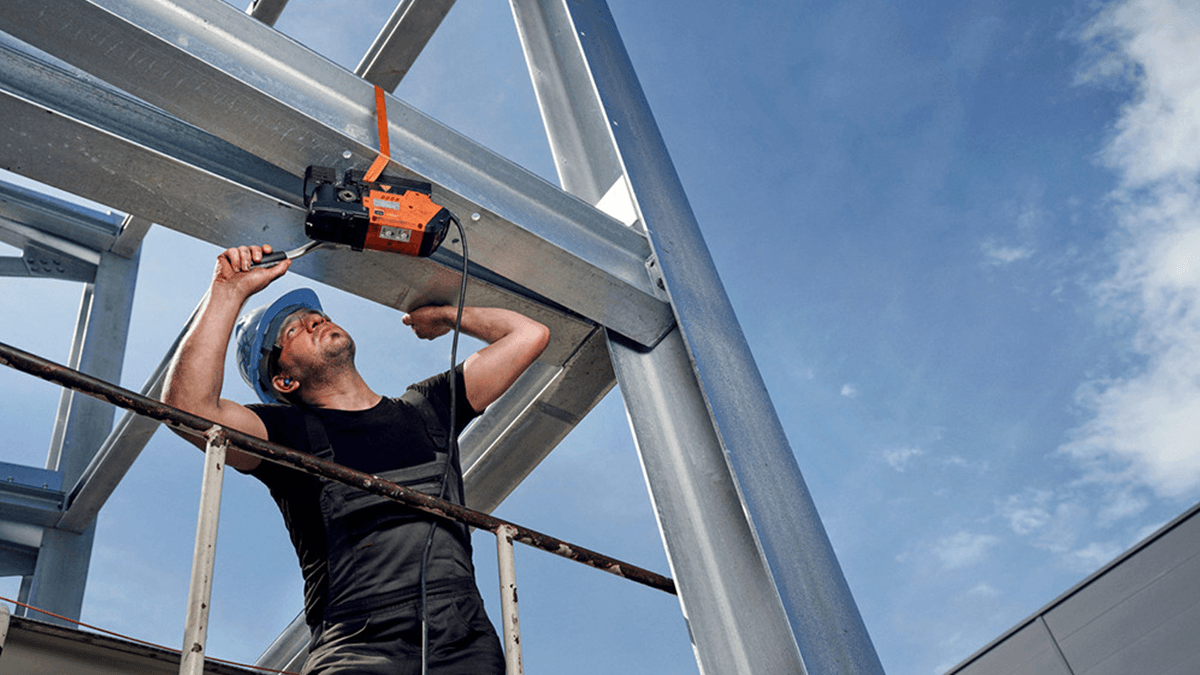
 A Mag Drill lets you bring the drilling machine to large, heavy, installed, or difficult-to-move steel.
What Is a Drill Press?
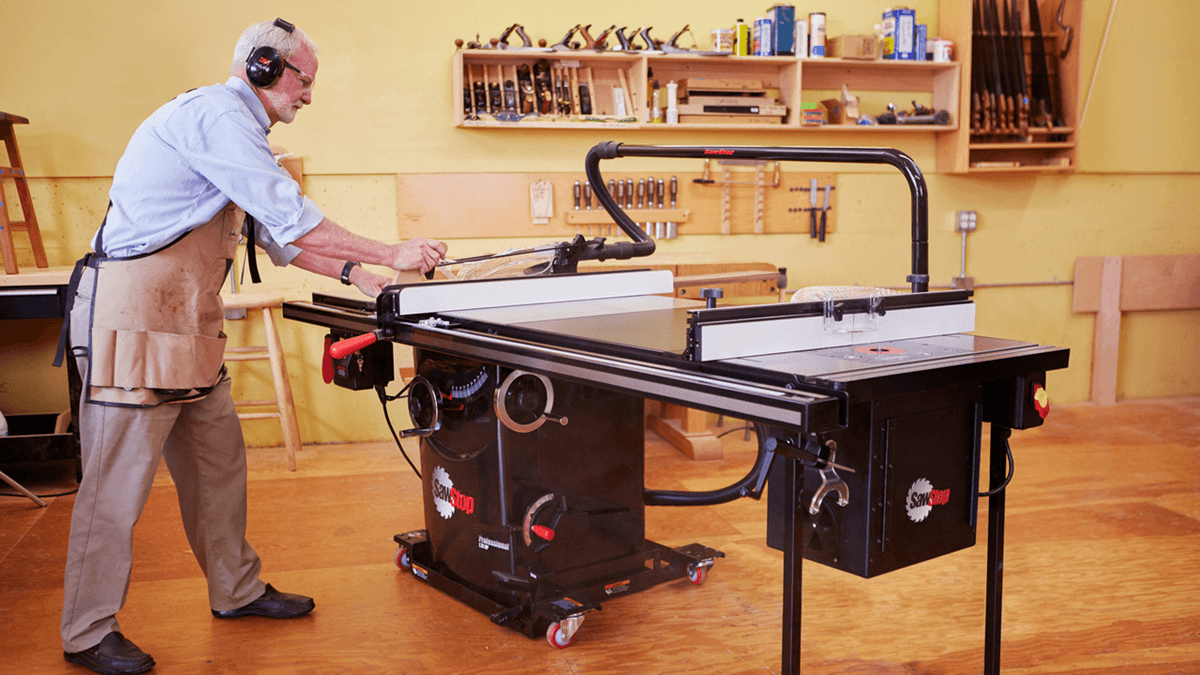
A drill press is a stationary drilling machine with the spindle mounted above a table. The workpiece is positioned and secured on that table, and the operator lowers the rotating tool into it using a feed handle.
Drill presses excel at controlled, repeatable shop work. Stops, fences, vises, fixtures, depth controls, and a fixed table make it relatively easy to drill the same hole in multiple parts or accurately reproduce a setup.
They are also highly versatile. Depending on the machine and tooling, a drill press can work with steel, aluminum, wood, plastics, and many other materials without depending on magnetic attraction.
Mag Drill vs Drill Press: What's the Real Difference?
The most important difference isn't simply portability. It is which part of the drilling operation moves.
With a drill press, you normally bring the workpiece to the machine. With a mag drill, you bring the machine to the workpiece.
That distinction becomes increasingly important as the work gets larger. A small steel bracket can easily be clamped to a drill press table. A structural beam that is already installed in a building cannot.
A mag drill is therefore not just a portable substitute for a drill press. It solves jobs that a conventional stationary drill press may not be able to reach at all.
Which Is More Accurate: A Mag Drill or Drill Press?
Both can produce accurate holes when properly set up. A drill press has the advantage when you need to position and drill a series of movable parts because the table, spindle, stops, vise, and fixtures can remain in the same relationship from one part to the next.
A mag drill can also produce precise holes, but the entire machine may need to be positioned again for each location. Its strength is achieving controlled drilling on work that cannot conveniently be placed on a stationary machine.
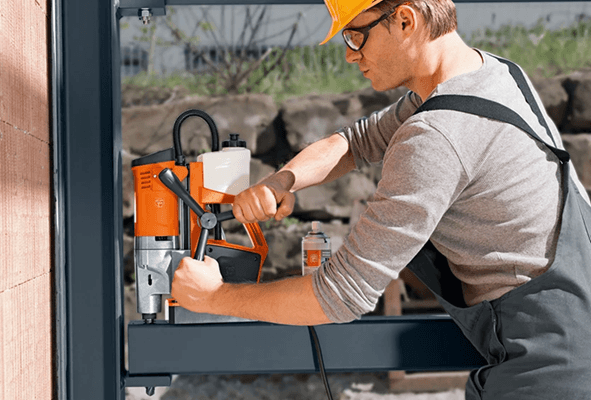 A Mag Drill goes places a drill press can'r reach.
When to Use a Magnetic Drill
A magnetic drill makes the most sense when the size, location, or orientation of the workpiece makes a stationary drill press inconvenient or impossible to use.
1. Drilling Structural Steel on Site
Structural steel is one of the classic mag drill applications. Beams, columns, frames, and other large components may be too heavy to move or may already be installed when a hole needs to be added.
Instead of transporting the steel back to a machine shop, a fabricator or ironworker can position a magnetic drill directly at the required hole location.
2. Drilling Large or Heavy Workpieces
A workpiece doesn't have to be part of a building to justify a mag drill. Large steel plates, machinery frames, tanks, fabricated assemblies, and other heavy components can all become impractical to position beneath a stationary drill press.
In these cases, portability means more than carrying the tool to a jobsite. It means being able to drill a part that is simply easier to leave where it is.
3. Bridge, Rail, and Field Fabrication Work
Mag drills are particularly useful when fabrication or repair work has to be performed in the field. Structural contractors, bridge crews, rail workers, welders, and industrial maintenance teams may need accurate holes far away from a conventional machine shop.
Corded machines can be used wherever suitable power is available, while cordless magnetic drills can eliminate the need to run an extension cord or generator to some remote work areas.
4. Vertical Drilling
One of the major advantages of a magnetic drill is its ability to attach to suitable vertical steel surfaces. That allows operators to drill components that would be extremely awkward or impossible to orient beneath a conventional drill press.
The important qualification is suitable. The magnet must have sufficient holding force on the actual surface, and the machine must be secured and operated according to the manufacturer's instructions.
5. Overhead Drilling
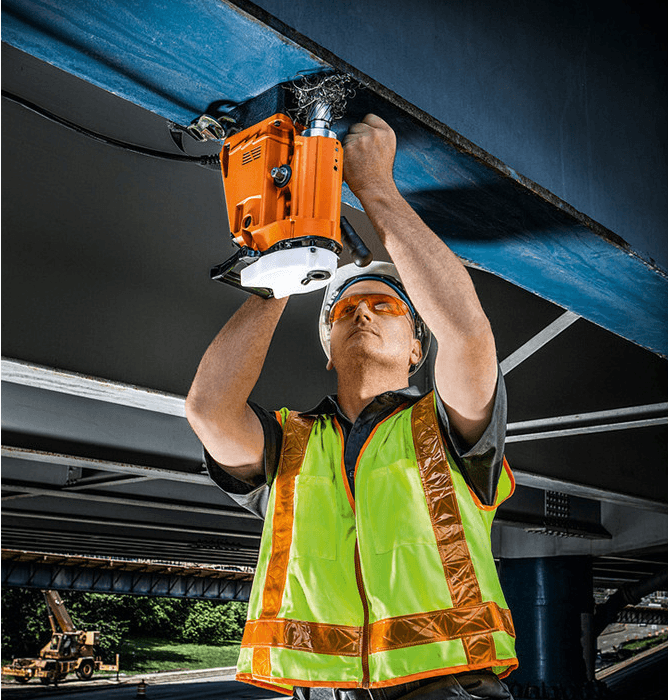
Some magnetic drills are designed for work in restricted, vertical, or overhead locations. This can make them valuable in structural construction and maintenance where the required hole is above the operator rather than on a horizontal workbench.
Overhead work creates additional hazards, however. The machine must be appropriate for the application, adequate magnetic holding force must be confirmed, and any required safety strap, chain, or secondary restraint must be used.
6. Making Larger Holes in Steel with Annular Cutters
Mag drills and annular cutters are a particularly effective combination for creating larger holes in steel.
A conventional twist drill cuts essentially the entire diameter of the hole into chips. An annular cutter removes material only around the perimeter and leaves a solid slug in the center.
Because less material has to be removed, annular cutting can make large-hole drilling in steel faster and more efficient than drilling the same hole with a large twist drill.
This doesn't mean every mag drill job requires an annular cutter. Many magnetic drills can use twist drills and other tooling as well. But if you're buying a mag drill primarily for structural steel, annular cutter capacity should be one of the specifications you compare.
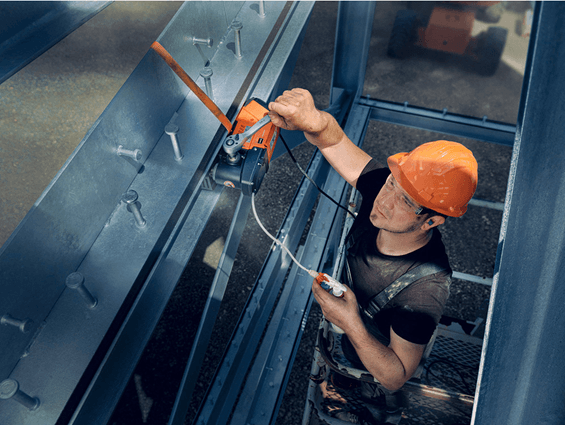 A Mag Drill is designed for access in hard-to-reach areas and easy overhead or vertical work.
 When Is a Drill Press the Better Choice?
A magnetic drill isn't automatically better simply because it is portable. If your workpieces can easily come to the machine, a drill press may be simpler, more versatile, and more economical.
Small Parts and Bench Work
If you're drilling brackets, plates, fixtures, or other relatively small components, carrying each part to a drill press is usually easier than positioning an entire magnetic drill for every hole.
The drill press also gives you a stable table for clamping and supporting small workpieces.
High-Repeatability Production
A drill press is especially useful when you need to make the same hole repeatedly. A vise, fence, fixture, or stop can locate successive workpieces without having to reposition the drilling machine itself.
That makes a drill press a natural choice for production runs involving many similar parts.
Smaller Holes
For ordinary small-diameter twist-drill work in parts that fit comfortably on the table, there may be little reason to set up a magnetic drill.
The mag drill begins to show its advantages when hole diameter, workpiece size, or job location makes conventional drilling less convenient.
Nonmagnetic Materials
A conventional magnetic base needs a suitable ferromagnetic surface in order to develop holding force. Aluminum is not magnetic, and some stainless steels have little or insufficient magnetic attraction for normal mag-drill use.
A drill press doesn't have that restriction. If your shop routinely switches among steel, aluminum, plastics, wood, and other materials, a drill press may be the more universally useful machine.
What Does a Mag Drill Need to Hold Safely?
A magnetic drill is only as secure as the connection between its base and the workpiece. You should never assume that turning on the magnet automatically means the machine has adequate holding force.
Magnetic holding force can be affected by the thickness and composition of the steel, surface condition, paint or coatings, rust, scale, debris, gaps beneath the magnetic base, and how much of the magnet is actually in contact with the workpiece.
A clean, flat steel surface generally allows the magnetic base to work much more effectively than a rough, dirty, heavily painted, thin, or irregular surface.
This is particularly important on vertical and overhead jobs. Always follow the drill manufacturer's requirements for minimum material thickness, magnetic holding force, secondary restraints, cutter use, and operating position.
Annular Cutters vs Twist Drills: Why It Matters
You don't have to use an annular cutter in every mag drill, but understanding the difference helps explain why magnetic drills are so common in steel fabrication.
A twist drill removes all of the material inside the finished hole. As hole diameter increases, the amount of metal that has to be converted into chips increases substantially.
An annular cutter is hollow. It cuts around the outside of the hole and ejects the center as a slug. For many larger holes in steel, this can reduce the amount of cutting required and allow efficient drilling with less feed force than an equivalent large twist drill.
For smaller holes and general-purpose work, twist drills can still make sense. For repeated larger holes in structural steel, annular cutters are often one of the major reasons to choose a magnetic drilling system.
Mag Drill Limitations to Consider
A mag drill solves some difficult problems, but it also introduces requirements that a stationary drill press doesn't have.
You Need a Suitable Magnetic Surface
A standard electromagnetic base is designed to attach to suitable ferromagnetic metal. It cannot simply be placed on any material.
Thin steel may also fail to provide the holding force that the drill is rated to produce on thicker material. Always check the manufacturer's minimum material requirements rather than assuming the magnet's advertised maximum holding force applies to every workpiece.
Surface Condition Matters
Rust, heavy paint, mill scale, chips, curvature, or an uneven surface can prevent full contact between the magnet and the steel.
Even a small air gap can significantly reduce magnetic holding force, so surface preparation and positioning matter.
The Machine Must Be Repositioned
A mag drill's portability is an advantage on large structures, but it can become a disadvantage if you're drilling dozens of small loose parts. Each new hole location may require the machine to be released, moved, aligned, and secured again.
That's exactly the kind of work where a stationary drill press with a fixture or stop can be faster.
Mag Drill Cost, Tooling, and Setup
A mag drill generally requires a larger investment than an entry-level drill press, but price alone isn't a useful way to choose between them. The two machines are often solving different problems.
A small benchtop drill press may cost far less than a professional magnetic drill, but it cannot replace a mag drill when the job involves drilling an installed structural beam several stories above the shop floor.
When budgeting for a mag drill, remember that the machine itself is only part of the system. Depending on the work, you may also need:
- Annular cutters in the required diameters and cutting depths
- Pilot pins
- Cutting fluid or coolant
- A chuck or adapter if you plan to use twist drills
- Safety chains, straps, or other restraints required by the manufacturer
- A suitable power source for corded machines
- Batteries and chargers for cordless models
If either machine can perform your work equally well, a drill press will often be the more economical shop solution. A mag drill earns its cost when bringing the drill to the workpiece saves labor, eliminates material handling, or makes an otherwise difficult drilling operation practical.
Browse magnetic drills at ToolsToday to compare cutter capacity, size, power source, magnetic holding force, and other specifications.
Mag Drill or Drill Press? A Simple Decision Guide
Choose a mag drill when the workpiece can't conveniently come to the machine. Choose a drill press when the workpiece is manageable and controlled, repeatable shop drilling is the priority.
A Mag Drill Makes Sense If:
- You're drilling structural or installed steel.
- The workpiece is too large, heavy, or awkward to move to a drill press.
- You need to drill in the field rather than in a machine shop.
- You regularly drill vertical steel surfaces.
- You have applications requiring an appropriate machine for overhead drilling.
- You frequently make larger holes with annular cutters.
- Moving the workpiece would cost more time than moving the drill.
A Drill Press Makes Sense If:
- Your workpieces easily fit on a drill press table.
- You need to make the same hole repeatedly in multiple parts.
- You rely heavily on fixtures, stops, and controlled positioning.
- Most of your work involves relatively small holes.
- You routinely drill nonmagnetic materials.
- You don't need to take the machine to a jobsite.
Do You Need Both?
For many fabrication shops, a mag drill and a drill press aren't competing tools at all.
The drill press handles smaller parts and repeat shop work. The mag drill comes out when the work is too large, too heavy, already installed, or somewhere the drill press can't go.
If you routinely work both in the shop and on structural steel in the field, having access to both machines may be far more useful than trying to make either one cover every drilling job.
FAQs
Can a mag drill replace a drill press?
Not completely. A mag drill can perform many drilling operations that overlap with a drill press, but the two machines are optimized for different situations. A mag drill is ideal when you need to bring the machine to large or installed steel, while a drill press is usually better for small parts, repetitive shop work, and nonmagnetic materials.
How thick of steel can a mag drill go through?
It depends on the drill and the cutter. Magnetic drills have specified cutter diameters, cutting depths, stroke lengths, and minimum material requirements, so there is no single maximum steel thickness that applies to every machine.
Also remember that cutting capacity and magnetic holding requirements are separate specifications. A cutter may be capable of drilling deeply into steel while the magnetic base still requires a certain minimum workpiece thickness to develop adequate holding force.
Do you need a permanent magnet or an electromagnetic base?
Most conventional mag drills use an electromagnetic base, but permanent-magnet magnetic drilling systems also exist. Electromagnetic machines rely on electrical power to energize the magnet, while a permanent magnet does not require electricity to maintain magnetic attraction.
The best choice depends on the machine, the working environment, available power, and the manufacturer's intended applications. Neither design removes the need to verify adequate holding force before drilling.
Can you use a mag drill on vertical or overhead surfaces?
Many magnetic drills can be used vertically, and some machines are specifically designed for restricted or overhead applications. The model must be suitable for the orientation, however, and magnetic holding force becomes particularly important when the machine is not sitting horizontally on top of the work.
Follow the manufacturer's instructions and use any required safety chain, strap, or secondary restraint.
Is a mag drill worth it for occasional use, or only for daily field work?
You don't have to use a mag drill every day for it to be worthwhile. The better question is whether the jobs you encounter actually require what a mag drill does.
If you occasionally need to drill large, heavy, installed, vertical, or otherwise immovable steel, buying or renting a mag drill can make sense even if it spends most of its time in storage. If every workpiece you drill can easily be carried to a stationary drill press, the additional cost and setup of a magnetic drill may be harder to justify.