Wood Hardness Chart: Janka Ratings for 30 Popular Wood Species
Table of Contents
- What Is the Janka Hardness Scale?
- How Is Wood Hardness Measured?
- What Do the Janka Numbers Actually Mean?
- Wood Hardness Chart: Janka Ratings for 30 Popular Wood Species
- Common Misconceptions About the Janka Scale
- What the Categories Mean
- How Wood Hardness Affects Machining
- Choosing the Right Wood for Your Project
- Quick Reference: Janka Hardness by Application
- Final Thoughts
- FAQs
Some species can be dented with a fingernail, while others are so dense they quickly dull cutting tools and challenge even experienced woodworkers. Whether you’re building furniture, choosing flooring, selecting material for a cutting board, or programming toolpaths for a CNC router, understanding wood hardness can help you achieve better results and avoid costly mistakes.
The most widely accepted way to compare wood hardness is the Janka Hardness Scale, a standardized test that measures how resistant a wood species is to denting and wear.
In this guide, we’ll explain how the Janka test works, what the numbers actually mean, and provide a comprehensive wood hardness chart covering 30 popular species. We’ll also discuss how hardness affects machining, tool wear, feed rates, burning, tearout, and project selection.
What Is the Janka Hardness Scale?
The Janka Hardness Scale measures the force required to embed a steel ball halfway into a piece of wood. Developed by Austrian-born researcher Gabriel Janka in the early 20th century, the test has become the industry standard for comparing the relative hardness of wood species.
During the test, a steel ball measuring 0.444 inches (11.28 mm) in diameter is pressed into the wood until exactly half of the ball’s diameter is embedded below the surface. The amount of force required to achieve this is recorded in pounds-force (lbf).
The higher the number, the harder the wood.
For example:
- Balsa requires only about 100 lbf.
- Hard Maple requires approximately 1,450 lbf.
- Ipe requires roughly 3,680 lbf.
This makes Ipe more than 36 times harder than Balsa according to the Janka test.
How Is Wood Hardness Measured?
The Janka test is designed to measure resistance to denting and wear rather than overall strength.
While hardness often correlates with durability, it does not measure:
- Bending strength
- Structural strength
- Stiffness
- Dimensional stability
- Rot resistance
- Machinability
This distinction is important because many woodworkers assume harder automatically means better. In reality, the best wood for a project depends on many factors beyond hardness alone.
For example, Hard Maple is significantly harder than Walnut, but many furniture makers find Walnut easier to machine and more forgiving during finishing.
What Do the Janka Numbers Actually Mean?
The Janka number represents the amount of force required to dent the wood surface. Higher numbers generally indicate:
- Greater resistance to dents and scratches
- Longer wear life in flooring applications
- Increased tool wear
- Greater machining difficulty
- Higher likelihood of burning if feed rates are too slow
As a general rule:
- Below 700 lbf: Soft and easy to machine
- 700–1,500 lbf: Moderate hardness and suitable for most furniture applications
- 1,500–2,500 lbf: Hard woods that require sharp tooling
- 2,500+ lbf: Extremely dense woods that can significantly increase tool wear
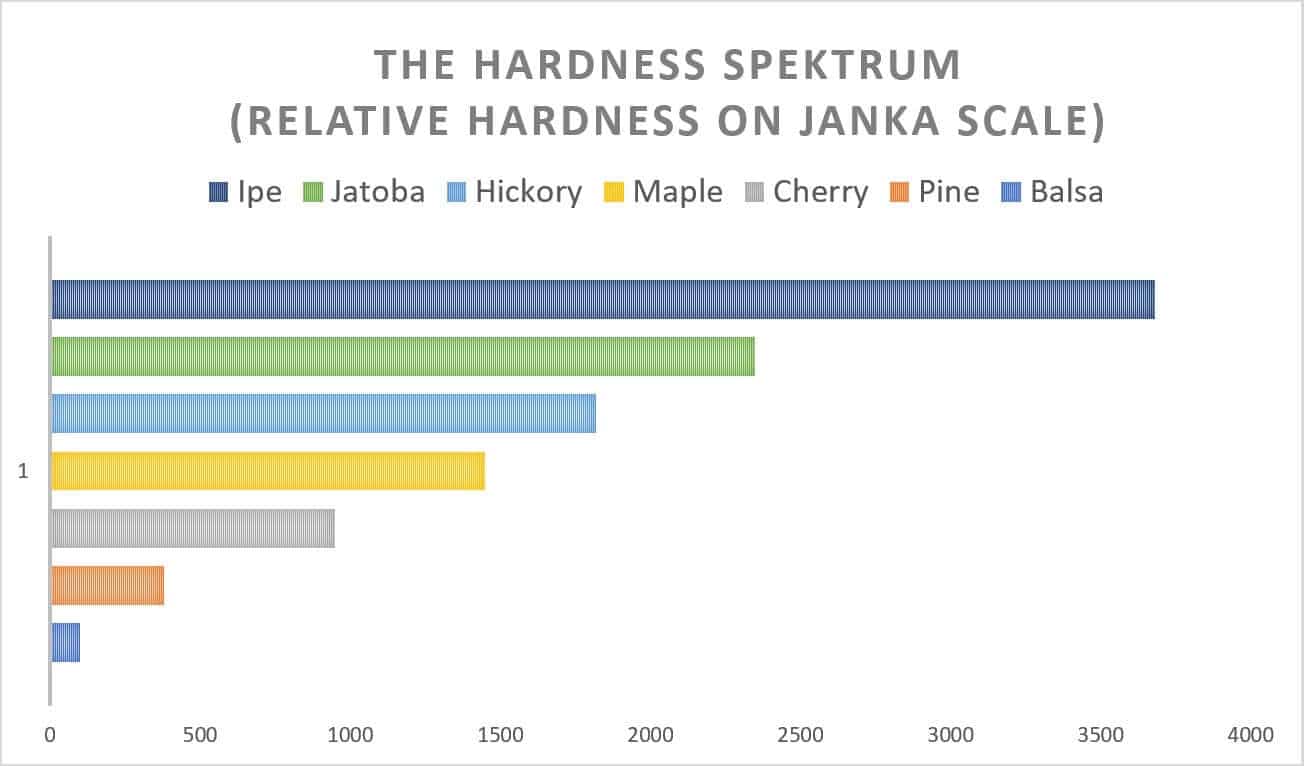
Wood Hardness Chart: Janka Ratings for 30 Popular Wood Species
| Wood Species | Approx. Janka Hardness (lbf) | Category |
|---|---|---|
| Balsa | 100 | Softwood & Easy-Machining |
| Western Red Cedar | 350 | Softwood & Easy-Machining |
| Eastern White Pine | 380 | Softwood & Easy-Machining |
| Basswood | 410 | Softwood & Easy-Machining |
| Cypress | 510 | Softwood & Easy-Machining |
| Spruce (Sitka) | 510 | Softwood & Easy-Machining |
| Poplar (Yellow Poplar) | 540 | Softwood & Easy-Machining |
| Alder (Red Alder) | 590 | Softwood & Easy-Machining |
| Douglas Fir | 660 | Softwood & Easy-Machining |
| Sycamore | 770 | Hardwood & Easy-Machining |
| Southern Yellow Pine | 870 | Softwood & Easy-Machining |
| Mahogany (Honduran) | 900 | Imported & Exotic Hardwood |
| Cherry (Black Cherry) | 950 | Domestic Hardwood |
| Walnut (Black Walnut) | 1,010 | Domestic Hardwood |
| Teak | 1,070 | Imported & Exotic Hardwood |
| Birch (Yellow Birch) | 1,260 | Domestic Hardwood |
| Red Oak | 1,290 | Domestic Hardwood |
| Beech (American Beech) | 1,300 | Domestic Hardwood |
| Ash (White Ash) | 1,320 | Domestic Hardwood |
| White Oak | 1,360 | Domestic Hardwood |
| Sapele | 1,410 | Imported & Exotic Hardwood |
| Hard Maple (Sugar Maple) | 1,450 | Domestic Hardwood |
| Hickory / Pecan | 1,820 | Domestic Hardwood |
| Wenge | 1,930 | Imported & Exotic Hardwood |
| Jatoba (Brazilian Cherry) | 2,350 | Imported & Exotic Hardwood |
| Bubinga | 2,410 | Imported & Exotic Hardwood |
| Purpleheart | 2,520 | Imported & Exotic Hardwood |
| Bamboo (Strand Woven) | 3,000+* | Engineered Material |
| Cumaru (Brazilian Teak) | 3,330 | Imported & Exotic Hardwood |
| Ipe | 3,680 | Imported & Exotic Hardwood |
*Bamboo is technically a grass rather than a wood, but engineered bamboo products are commonly compared using Janka hardness ratings.
Common Misconceptions About the Janka Scale
- Harder Isn’t Always Better:
- Many first-time buyers assume that the hardest wood must be the best choice. In reality, extremely hard woods often cost more, require more machining time, and accelerate tool wear.
- A furniture maker may prefer Cherry or Walnut over Hickory because those woods machine more predictably and finish beautifully despite being softer.
- Hardness Does Not Measure Stiffness:
- Two species with similar Janka ratings may have very different structural properties. Engineers rely on additional measurements such as modulus of elasticity and bending strength when evaluating structural lumber.
- Hardness Does Not Equal Machinability:
- Grain structure, silica content, moisture content, and resin content all affect how a species cuts.
- Some softer woods can produce more tearout than significantly harder species. Likewise, certain tropical hardwoods contain minerals and silica that can dramatically increase cutter wear regardless of their Janka rating.
What the Categories Mean
Softwoods & Easy-Machining Woods
These woods are generally easier to cut, route, carve, drill, and sand than harder hardwood species. They place less stress on router bits and saw blades, making them popular choices for beginners, production shops, painted projects, and CNC carving applications.
Best Uses
- Wood Carving & CNC Carving
- Basswood
- Poplar
- Pine
- Painted Furniture & Cabinetry
- Poplar
- Alder
- Outdoor Projects
- Western Red Cedar
- Cypress
- Construction & Structural Applications
- Douglas Fir
- Southern Yellow Pine
- Spruce
Machining Notes
Most species in this category cut easily with standard carbide tooling and are forgiving of minor feed-rate mistakes. However, softer does not always mean easier.
Resinous woods such as pine can burn when dull tooling generates excessive heat. Cedar’s soft fibers may fuzz during routing, while Douglas Fir’s pronounced grain structure can lead to tearout if cutting against the grain.
Because these woods offer relatively little resistance to the cutting edge, they generally produce less tool wear than harder species. This makes them ideal for learning new techniques or testing CNC programs before moving to more expensive materials.
Popular Domestic Hardwoods
These species are among the most common hardwoods used in North American woodworking. They offer an attractive balance of appearance, durability, workability, and availability, making them staples of furniture shops, cabinet makers, and serious hobbyists.
Best Uses
- Fine Furniture
- Cherry
- Walnut
- White Oak
- Cabinetry
- Cherry
- Maple
- Birch
- Flooring
- White Oak
- Red Oak
- Hard Maple
- Hickory
- Workbenches
- Hard Maple
- Beech
- Tool Handles & High-Impact Applications
- Hickory
- Ash
Machining Notes
This category represents the sweet spot for many woodworkers. Most domestic hardwoods are durable enough for demanding applications while remaining relatively predictable to machine.
Cherry and Walnut are widely considered among the most pleasant woods to work with. They machine cleanly, respond well to hand tools, and typically produce excellent finishes.
At the harder end of the spectrum, Maple and Hickory demand sharper tooling and more attention to heat buildup. Slow feed rates can quickly cause burning, particularly when routing Hard Maple.
Oak species deserve special mention. Their open grain structure machines well with sharp cutters but can produce tearout if grain direction is ignored. White Oak’s density and high tannin content can also contribute to faster tool wear than many woodworkers expect.
Common Imported & Exotic Hardwoods
Imported and exotic hardwoods are often selected for their unique appearance, exceptional durability, and resistance to wear. Many of these species command premium prices and require a more deliberate approach to machining.
Best Uses
- Premium Furniture
- Mahogany
- Sapele
- Bubinga
- Decorative Accents & Inlays
- Purpleheart
- Wenge
- Exterior Projects & Decking
- Ipe
- Cumaru
- Teak
- High-Wear Surfaces
- Jatoba
- Ipe
- Cumaru
Machining Notes
Exotic hardwoods often challenge tooling in ways that domestic species do not. Many contain oils, silica, or dense interlocking grain structures that increase cutting resistance and accelerate wear.
Teak, for example, contains natural oils that contribute to its legendary weather resistance but can complicate gluing and finishing. Wenge’s coarse grain can splinter aggressively, while Purpleheart’s density demands sharp cutters and adequate chip evacuation.
Among the hardest woods commonly available, Ipe and Cumaru are notorious for dulling tools. Multiple shallow passes often produce better results than aggressive cuts, particularly when routing profiles or machining deep pockets.
For production environments, premium carbide tooling frequently pays for itself when machining dense tropical hardwoods.
Special Mention: Bamboo
Although bamboo is technically a grass rather than a wood, many engineered bamboo products are included in Janka comparisons because of their exceptional hardness.
Strand-woven bamboo products often exceed 3,000 lbf on the Janka scale, placing them among the hardest materials commonly used for flooring and furniture.
However, bamboo presents unique machining challenges. The adhesives used during manufacturing, combined with its dense fiber structure, can accelerate tool wear and produce more heat than many woodworkers expect.
Sharp carbide tooling is strongly recommended when cutting or routing engineered bamboo products.
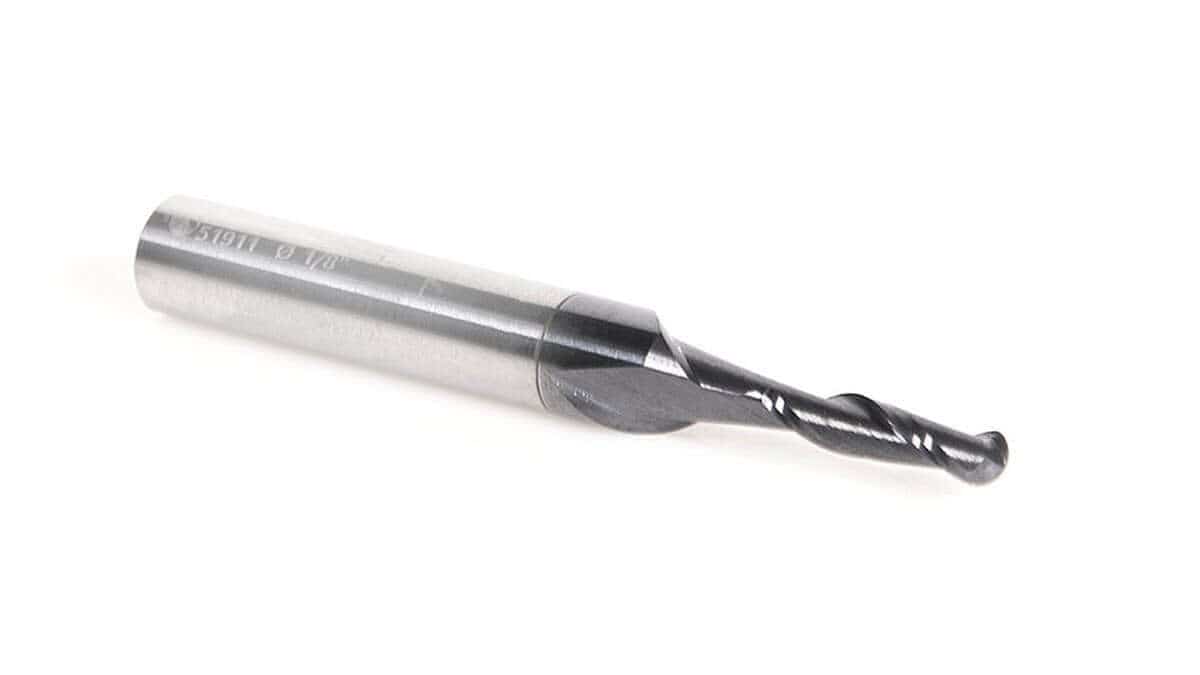
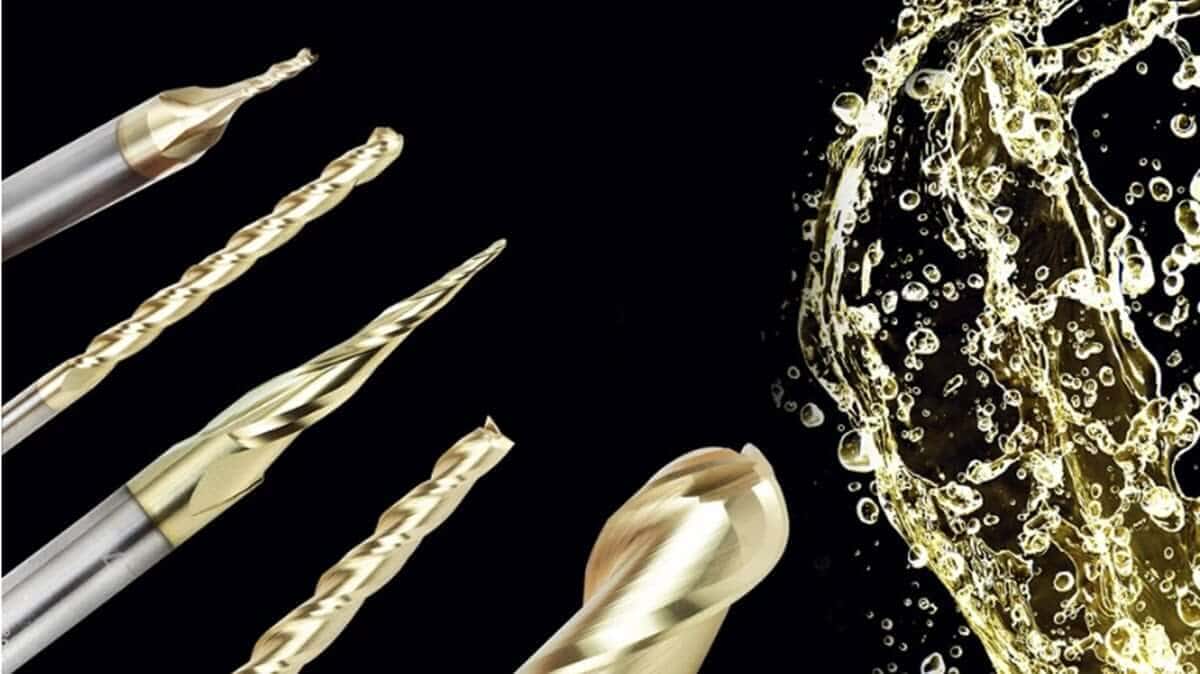
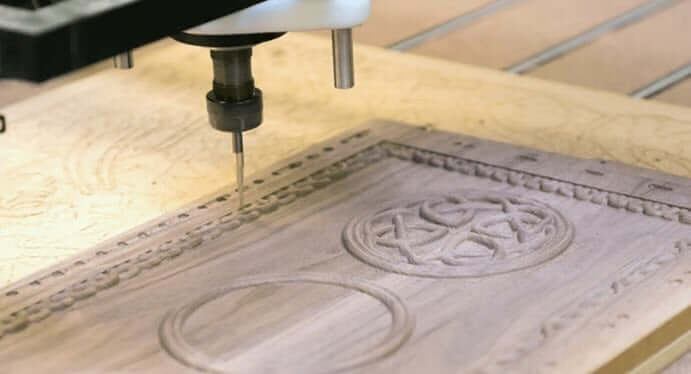 Amana Tool® Precision CNC Tooling is engineered to deliver superior cutting quality on even the hardest of woods (and other materials).
How Wood Hardness Affects Machining
While the Janka scale measures resistance to denting, wood hardness also has a significant impact on machining performance. Understanding these effects can help woodworkers choose appropriate tooling, improve cut quality, and extend tool life.
Router Bit Wear
As hardness increases, so does resistance to the cutting edge. Harder woods generate greater friction and place more stress on carbide cutting edges.
Species such as Hard Maple, Hickory, Purpleheart, Cumaru, and Ipe can noticeably shorten tool life compared to softer species like Poplar, Pine, or Basswood.
In production environments, premium carbide tooling often delivers measurable benefits when machining dense hardwoods because the cutting edge remains sharp longer.
Saw Blade Wear
The same principles apply to saw blades. Dense woods require more cutting force, generate additional heat, and gradually wear cutting edges faster.
Species containing silica or mineral deposits can be particularly abrasive. A blade that performs flawlessly in Cherry may dull significantly faster when repeatedly cutting tropical hardwoods.
Feed Rates
Many woodworkers assume harder woods always require slower feed rates. In reality, the relationship is more complicated.
Running too slowly can create excessive heat, causing burning and premature tool wear. The goal is to maintain a healthy chip load that allows the cutting edge to remove material efficiently while carrying heat away from the cut.
Harder woods often require shallower passes, but not necessarily dramatically slower feed rates.
Burning
Burning occurs when friction generates more heat than the material can dissipate.
Hard Maple is perhaps the most famous example. A dull router bit or a slow feed rate can quickly leave dark burn marks along an edge profile.
Sharp tooling, proper spindle speeds, and consistent feed rates are the best defense against burning.
Tearout
Hardness alone does not determine tearout.
Grain direction, grain structure, cutter geometry, and feed direction often play a larger role. Woods with interlocked or highly figured grain can tear out severely despite moderate Janka ratings.
Sharp cutters, climb-cutting where appropriate, and taking lighter finishing passes can dramatically improve surface quality.
Sanding
Softer woods generally sand quickly but may show scratches more easily. Harder woods often require more time and effort to sand but can produce exceptionally smooth finished surfaces.
Dense species such as Maple, Jatoba, and Purpleheart frequently reward patient sanding with a glass-like finish.
For very hard woods, consider Amana Tool® IN-SAND™ Dynamically Balanced Non-Random Orbital CNC Sanders.
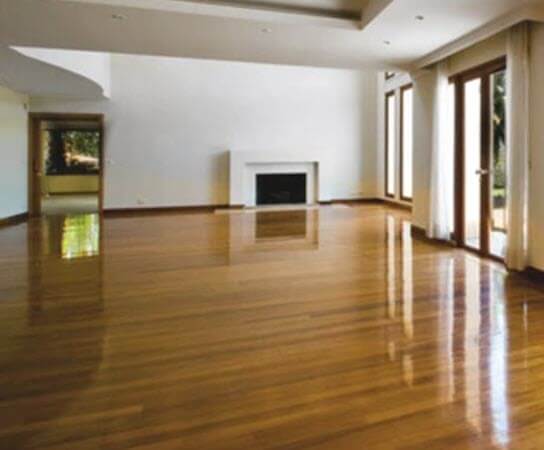
Amana Tool’s flooring router bit collection includes a carbide tipped tongue & groove 2-piece router bit set with nail slot, ideal for producing your own custom hardwood floors. See tongue & groove router bits for 1/2" to 5/8" materialSee tongue & groove router bits for 5/8" to 3/4" material
Choosing the Right Wood for Your Project
While the Janka Hardness Scale provides a useful way to compare wood species, hardness should be only one factor in your decision. Appearance, stability, workability, moisture resistance, cost, and availability can be just as important depending on the project.
Here are some general guidelines for matching wood species to common woodworking applications.
Best Woods for Flooring
Flooring must withstand years of foot traffic, dropped objects, pets, and furniture movement. Higher Janka ratings generally provide better resistance to dents and wear.
Popular flooring choices include:
- White Oak (1,360) – Durable, attractive, and widely available.
- Hard Maple (1,450) – Excellent wear resistance and a clean, modern appearance.
- Hickory (1,820) – One of the toughest domestic flooring options.
- Jatoba (2,350) – Extremely durable exotic flooring.
- Bamboo (3,000+) – Popular engineered option with exceptional hardness.
That said, hardness is not everything. Many homeowners happily choose Cherry or Walnut flooring despite their lower Janka ratings because of their rich color and character.
Best Woods for Cutting Boards
Cutting boards require a balance of hardness and knife friendliness. Extremely soft woods dent easily, while extremely hard woods can be tougher on knife edges.
Popular cutting board woods include:
- Hard Maple
- Beech
- Walnut
- Cherry
Hard Maple remains the industry favorite because it offers an excellent balance of durability, food safety, and workability.
Open-grained woods such as Red Oak are generally avoided because their large pores can trap moisture and bacteria.
Best Woods for Cabinetry
Cabinet makers often prioritize appearance, stability, and ease of machining over maximum hardness.
Common cabinet woods include:
- Cherry
- Maple
- Birch
- Walnut
- Red Oak
- White Oak
Cherry and Walnut are particularly valued because they machine beautifully and develop rich character over time.
For painted cabinetry, Poplar remains a popular choice thanks to its affordability, smooth surface, and ease of machining.
Best Woods for Furniture
Furniture projects often benefit from woods that combine attractive grain patterns with predictable machining characteristics.
Excellent furniture woods include:
- Cherry
- Walnut
- White Oak
- Mahogany
- Sapele
- Ash
Many professional furniture makers consider Walnut and Cherry among the most rewarding woods to work with because they machine cleanly, finish well, and remain stable in service.
Best Woods for Outdoor Projects
Outdoor applications place unique demands on wood. Rot resistance and weather durability often matter more than hardness.
Popular outdoor choices include:
- Western Red Cedar
- Cypress
- Teak
- Ipe
- Cumaru
While Ipe and Cumaru offer remarkable durability, their extreme hardness can make machining and fastening more difficult than softer alternatives such as Cedar.
Quick Reference: Janka Hardness by Application
| Application | Recommended Hardness Range | Popular Choices |
|---|---|---|
| Wood Carving | 100–600 | Basswood, Poplar, Pine |
| Painted Furniture | 400–700 | Poplar, Alder |
| Cabinetry | 900–1,500 | Cherry, Maple, Birch |
| Fine Furniture | 900–1,500 | Cherry, Walnut, White Oak |
| Cutting Boards | 1,000–1,500 | Maple, Beech, Walnut |
| Flooring | 1,300+ | Oak, Maple, Hickory |
| Decking | 1,000–3,700 | Cedar, Teak, Ipe |
Final Thoughts
The Janka Hardness Scale provides a valuable way to compare wood species, but it should be viewed as a starting point rather than the final word.
A wood's hardness influences everything from dent resistance and flooring durability to tool wear and machining performance. However, grain structure, stability, appearance, moisture resistance, and workability all play important roles in determining whether a species is right for a particular project.
For woodworkers, understanding Janka ratings can help set realistic expectations before the first cut is made. Knowing that Basswood behaves differently than Hard Maple—or that Ipe demands a different machining strategy than Cherry—can lead to cleaner cuts, longer tool life, and better finished results.
The best wood isn't necessarily the hardest wood. It's the wood that best balances performance, appearance, workability, and cost for the job at hand.
FAQs
What is the hardest wood on the Janka scale?
Among the species commonly available in North America, Ipe is one of the hardest, with a Janka rating of approximately 3,680 lbf. Some less common tropical species can exceed 4,000 lbf.
What is the softest wood?
Balsa is widely recognized as one of the softest commercial woods, with a Janka rating of roughly 100 lbf.
Is hardwood always harder than softwood?
No. The terms hardwood and softwood refer to how trees reproduce, not how hard the wood is. Some softwoods, such as Southern Yellow Pine, are harder than certain hardwoods. Sycamore is a "hardwood" but relatively soft & easy to machine compared to dense hardwoods like oak or hickory.
Is a higher Janka rating always better?
Not necessarily. Harder woods are often more durable, but they can also be more expensive, more difficult to machine, and tougher on cutting tools.
What is the best wood for cutting boards?
Hard Maple is generally considered the gold standard for cutting boards because it offers an excellent balance of hardness, durability, and workability.
Which woods are hardest on router bits?
Dense tropical hardwoods such as Ipe, Cumaru, Purpleheart, and Jatoba can significantly increase tool wear. Hard Maple and Hickory can also be demanding on cutting edges during extended production runs.
Does harder wood require slower feed rates?
Not always. While harder woods often require shallower passes, excessively slow feed rates can create heat buildup, burning, and premature tool wear. Proper chip load is usually more important than simply reducing feed speed.
Why does Maple burn so easily?
Hard Maple's density makes it particularly susceptible to friction-related burn marks. Dull tooling, high spindle speeds, or slow feed rates can quickly generate enough heat to discolor the wood.